Tuesday, September 18, 2012

More Arequipa

Arequipa was a kind of colonial religious center, and you can see wonderful architectural detail blending Incan & Christian themes.

Here's a stone carving on a church, showing Christ dressed as the supreme Inca.


Another detail from the same church. This religious figure is wearing a crown of feathers, which was the sign of supreme authority in the Inca culture.


Finally, here's a depiction of the Last Supper with Maize & Cuy (Guinea Pig) as the main course. Sorry it's such a poor photo due to not using the flash. Anyway, I just had to include it here!


On the theme of Cuy - yes, I did give it a try! It was fine, but very bony: more like eating the idea of meat than meat itself. Guinea pig has been a dietary staple in Peru for hundreds of years, as this story illustrates: while in Arequipa, I visited a colonial-era Convent that housed the daughters of the aristocracy. It was quite posh: each woman had her own private casita and multiple servants attending her. The casitas are 2 stories tall. Downstairs are the living quarters and kitchen, and upstairs is the terrace where they raised their own guinea pigs. Somehow the contrast between the luxurious religious retreat & cute little guinea pigs running around on the roof was really charming.

Here is a picture of that convent at nightfall, with the volcano Misti in the background.

Vacation - Arequipa

Well it's literally my last day in Peru & I'm ticking away the hours until the cab comes to take me to the airport, so this seemed like a perfect time to do some blogging. Because I certainly won't have time to describe my whole visit, I will greedily skip to the best parts first.

My vacation! I spent 1 wonderful week in southern Peru, starting in the Spanish colonial town of Arequipa. Arequipa is surrounded by 3 towering volcanoes, and it's often called "The White City" because it was entirely constructed from a white stone mined from the craters. It's a lovely place and jammed with tourists.

Here is the Plaza de Armas...


There are these wonderful arcaded balconies where you can sit & have an overpriced drink.


The city has such a stark, simple beauty now, but apparently the exterior walls of the buildings used to be covcred with colorful murals like this; it's hard to imagine:


Arequipa is known for its wonderful food, and my guide & I had a leisurely, traditional lunch. For drinks, they serve Red Chicha, a non-alcoholic drink made from maize. Here I am with the waiter who is serving it up in the traditional way.

Sunday, September 9, 2012

PERU: Gods of Above & Below

Hola a todos! The blog is back - this time from Peru. I've been here about 3 weeks & there is so much to tell you.

What has struck me most is the incredible stretch of history in this place. Of course, when you think about Peru, Machu Picchu and the Incas come to mind, but there were actually empires that predated that by thousands of years. In fact, Peru was home to the oldest known civilization on the American continents (the Carals, from 3000-2500 BC). More recently - like from 100 to 700 AD! - there were vast Moche & Nazca empires in the north and south of the country. With all this ancient history, the Incas are starting to seem quite recent to me.

These ancient civilizations shared a belief in a 3-part world: the world of above, represented by the Condor; the 'earthly' world where humans live, represented by the Puma; and the underworld, represented by the Snake.

The Sky - Condors evoked power and supreme authority. Here is a golden outfit that a warrior would have worn into battle, complete with bird nose to strike fear into the enemy.


When the Spanish brought Christianity to Peru, they often portrayed Christ wearing a tall feather headdress, as an Incan or pre-Incan emperor would have done. Again, feathers and birds were considered god-like.


I was lucky enough to see actual Andean Condors when I was on vacation in the Canon del Colca. Andean Condors are giants; they have the largest wingspan of any land bird (about 10 or 11 feet). No wonder ancient peoples thought they were gods!


The Earth - in indigenous cultures, it was represented by the Puma god. When the Spanish arrived in Peru and wanted to put an end to this idolatry, they created art that showed a tamed and domesticated puma. Rather than the puma ruling as a god, it was now man who had dominion over nature. To the Incas, this would have been shocking. Here is an example:


The Underworld - ancient peoples associated it not only with death, but also with fertility. Every year, they put seeds in the ground and saw them grow, so they believed the underworld must be a place of fecundity and procreation, as well as a place for the dead. This is why Moche art often depicts corpses masturbating or copulating. Here are some examples from the wonderful Larco Museum in Lima.


More installments soon!

Monday, September 19, 2011

BRAZIL: Ibirapuera Park

In my temporary digs, I am just a few blocks away from Ibirapuera Park, the Central Park of Sao Paulo. September 7th is National Independence Day in Brazil, so I took at stroll over to the Park. It was full of people jogging, picnic-ing, visiting the museums that are scattered throughout it, and generally enjoying themselves.

Picnics, with the city skyline in the background...


The coconut juice vendor...


I love the tall old trees...


Recycling - it's everywhere here! A very strong theme...


The "Monumento as Bandeiros." This bears a little more explanation. The Bandeirantes or "Flag Bearers" were racially-mixed people descended from unions between the Portuguese and the indigenous Tupi people. Some of these men formed bands that scoured the Brazilian interior in search of local people to enslave. Their round-ups could last a year or two, and they brought back groups of hundreds to thousands of people to sell into slavery in the cities that hugged Brazil's coast. The colonization of Brazil was heavily dependent on slave labor. With its small population, tiny Portugal couldn't hope to supply enough colonists to work and settle their huge south American possession. The slave trade - both from the Brazilian interior and from Africa - helped to fill this gap. Brazil's slave trade long outlasted slavery in the US and was much larger in scope, impacting 7 times more people.

The Brazilians I have talked to don't seem to view this as unsavory or an embarrassing chapter in their history. Instead, the Bandeirantes are considered to be a kind of cowboys or land pirates who significantly expanded the borders of Portuguese America. There is a major street in Sao Paulo called "Bandeirantes," and the monument below prominently celebrates them. This unconflicted attitude is related to the lack of political engagement that I see among Brazilians. (If this were Argentina, there would be daily protests at the monument and contentious debates on TV!). The stereotype of Brazilians as having a "don't worry be happy" attitude to life may be an exaggeration, but it's got some basis in reality.


For some reason, people can't resist climbing on the Monument, which produces some charming scenes...


The Monument with Ibirapuera's fountains in the background...

Public Behavior

Last weekend, my friend took me to the Mercado Municipal and the nearby shopping streets downtown. In the discount stores, people push by you in a very assertivee way! It didn't bother me, but my Brazilian friend was quite embarrassed, and she kept apologizing, shaking her head and saying "it's not educated behavior! They are not educated!"

A few days later, I was talking with some Brazilian friends about my experiences in Argentina and I mentioned the remarkable public politeness I had observed there: people giving up their seats on the subway to the elderly, helping people who seem ill or distressed, retrieving dropped items for strangers on the street, and so on. One of my coworkers attributed this strong social code to the educational system. Argentina has one of the broadest educational systems in Latin America, with very high literacy rates. My friend's argument was that one result of having broad-based education is that people acquire a sense of civic duty and literally learn how to behave. I found this fascinating - it's the kind of thing we don't tend to think about in the developed world - and the more I think about it, the more on-target it seems.

Saturday, September 17, 2011

Food & Food Culture


I love discovering the tropical fruits that don't even exist back home; instead of defining them, my dictionary can only mumble that there is "no equivalent" in English. Here is the Caju fruit - it's strange, pulpy and milky to eat, but delicious in juice. The green nubbin on top is actually a "cashew nut" - or it will be, once it's properly processed. Until the nuts are roasted, they are actually toxic.


More beautiful fruit at the Mercado Municipal...


Palmito (hearts of palm) are a common ingredient in everything...


"Bacalhau" or salt cod: a reminder of Brazil's past as a Portuguese colony...


Like Argentina, Brazil has had significant Italian immigration. One of the most traditional lunches is a Mortadela sandwich...


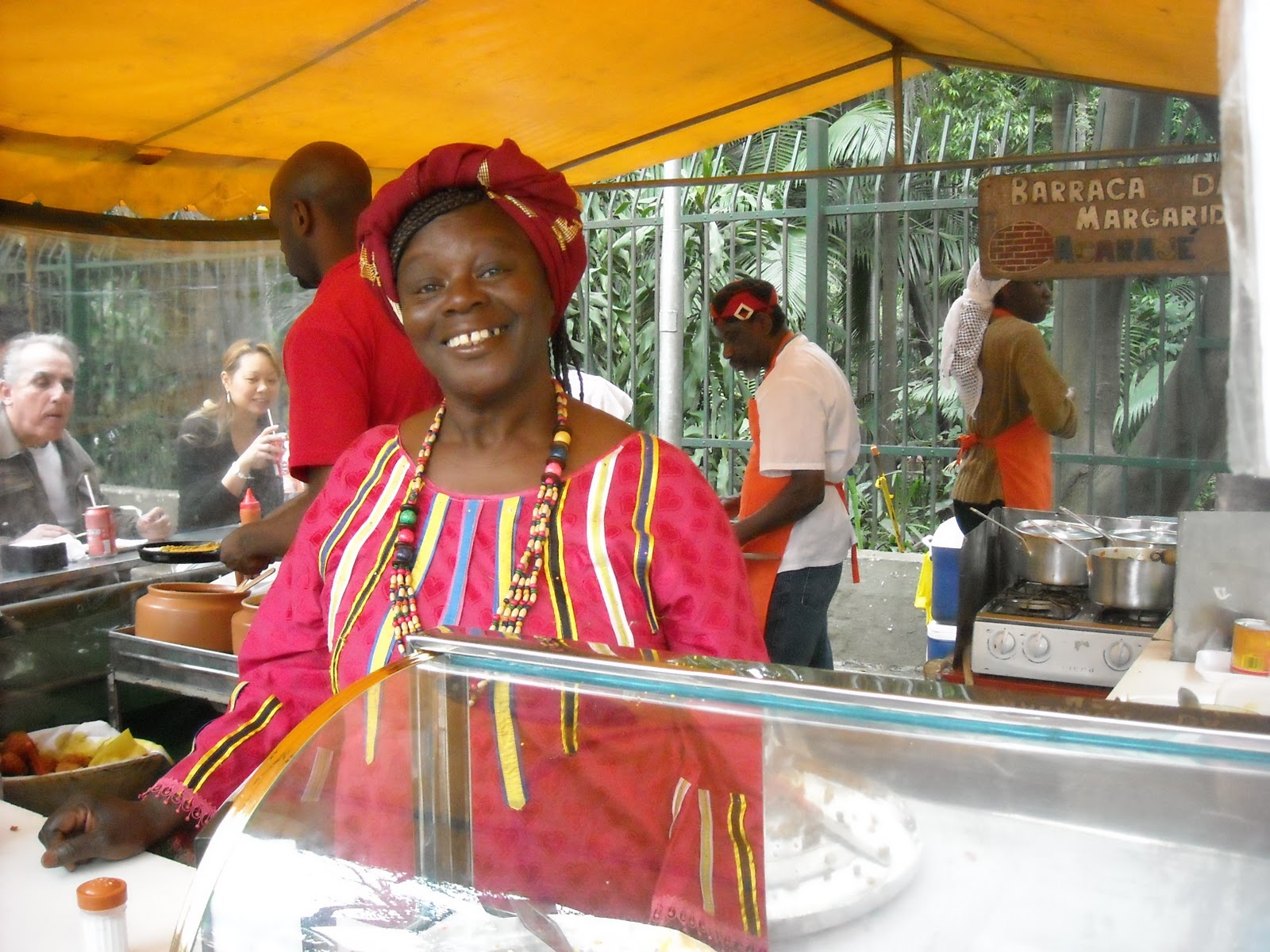
There are strong regional differences in Brazil, but the cradle of the culture is around Bahia and Recipe in the northeast. Here is a vendor at a street fair selling traditional Bahian food and wearing traditional dress.


I had a fried manioc ball, with sauces and little dried shrimps. The green sauce was almost like a guacamole!


Bem-vindo a Sao Paulo!

Adding to this year's adventures, I'm now spending several weeks in Sao Paulo! My visit here is very different than my stay in Argentina: it's shorter, I don't speak the language (Portuguese), and my focus is necessarily more on work than it was in my foray further south. In some ways, then, I feel less immersed in the culture here than I was in Buenos Aires. On the other hand, I am fully incorporated into the local team here, and that has given me a richer and more connected experience.

Having these two experiences back to back has attuned me to the differences in Brazilian & Argentinian culture; here are a few:

In Argentina, the political engagement was palpable. Love her or hate her, President Kirchener was in the news constantly, and the press gave detailed coverage even to non-events like her trade delegation visit to Italy. Political protests are daily events in Buenos Aires, and they often close the major arteries, snarling traffic for hours. As the shadow of the dictatorship passes, young Argentinians increasingly feel empowered to work through the political system to shape their national future. When President Humala, a long-term ally of the Kirchener family, was elected in Peru, there was an excited buzz about the growth of a moderate-leftist block in the Southern Cone. The hard reality is that the Argentinian economy continues to go sideways, and many fear that a crisis may be looming. But coexisting with that sense of uncertainty is an earnest excitement among many Argentinians who feel newly empowered to shape their country's future.

The situation in Brazil is quite different. Brazilians have a reputation for being apolitical, and I've found this to be the case. People here don't raise the subject of politics with me, and when it does come up, the conversation doesn't go much deeper than head-shaking over political corruption and inadequate infrastructure. Party affiliation is weak here: ordinary people don't seem to identify with one political group or the other - a striking contrast with Argentina, where the political machines have formed youth groups and neighborhood associations that bring politics into people's daily lives.

If politics is not a dominant theme in Brazil, money is: Brazilians are known to be committed consumers. Public life in Sao Paulo revolves around its shopping malls, which are sprinkled throughout the city. Prime time television routinely airs shopping shows where the hosts walk through a store and talk about what is for sale and how much it costs; other Consumer Reports-type shows put manufacturers' claims to the test. Though superficial in one sense, the focus on spending is understandable and even exciting given the economic boom here and way it is raising scores of people from abject poverty into improved circumstances.
A final point of contrast: I find Brazilians to be forward-looking, less focused on history than on what the future may bring. For Argentinians, on the other hand, the past is still present in so many ways. In the 1930s, Argentina was one of the richest countries in the world, and the feeling of lost glory weighs heavy on the national psyche. The legacy of the dictatorship still has Argentinians talking of the need for justice and national reconciliation - even 20 years after its fall. The tango, Argentina's traditional dance, is based in feelings of loss and longing. "Saudade" meaning longing or nostalgia is a Brazilian word, but I feel it better describes the Argentinian world view. I feel a seriousness, an earnestness, and a traditionalism in Argentina that I don't feel in Brazil.

Brazil (or at least Sao Paulo) is all about the future: growth, development, and a new-found role on the world stage. Explosive growth has almost obliterated any trace of traditional architecture and any sense of the past. Brazilians are unconflicted about this: modern architecture is the rage - the newer and cleaner, the better. While Argentinians seem almost French in their traditionalism and their love of complexity, Brazilian Paulistas remind me of LA.